Hello, HR Brew readers. March Madness ends in April. Let this be a lesson to take all the time you need to get your next big project done. You deserve it.
In today’s edition:
 Carpool Carpool
 Instagram recruiting Instagram recruiting
 Robots are trending Robots are trending
—Adam DeRose, Aman Kidwai, Hayden Field
|
|
Yauhen Akulich/Getty Images
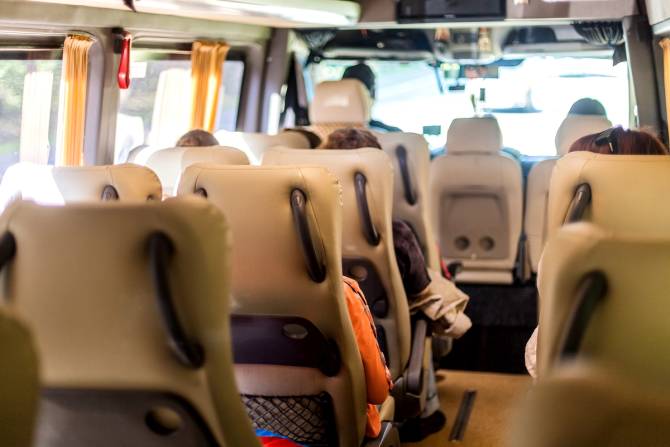
Carpooling isn’t just for moms with minivans anymore.
Services that help to connect commuters and get them to work, particularly outside urban centers, can be a useful recruitment and retention tool for HR, especially for a workforce with limited access to their own transportation.
When snack bars and seed butter manufacturer 88 Acres outgrew its commercial kitchen space in the Dorchester neighborhood of Boston, it ended up securing a new location in Canton, Massachusetts, about 30 minutes away from its original spot. The facility was expansive enough that management could imagine the company growing there.
There was only one problem.
“Almost all of our team that actually makes the product that fuels every other department doesn’t necessarily have the means to get to this new location,” said Rebecca Short, HR generalist at 88 Acres. “So, what are we gonna do about that?”
Short needed to figure out a way to retain workers after the move. Nearly all of the employees lived within three miles of the Dorchester bakery, according to Short, and she told us that about 70% walked to work or used public transportation. Many didn’t have a driver’s license or access to a car.
“We really wanted to present our team with the solution and not just go…‘We are moving, and we don’t know how we’re gonna get you there but we’re hoping to,’ and have our team leave or just panic,” she said.
Keep reading.—AD
|
|
TOGETHER WITH FRANKLIN TEMPLETON
|
|
The American workforce has a lot going on these days. In fact, 79% of workers say their finances affect their mental health—and everyone’s been, well, a little more cash-strapped lately. So how can your biz start supporting employees?
Enter Franklin Templeton. They’ve just released the 2023 results of their annual Voice of the American Worker Survey, a study that’s got all the deets on what your people want and how you can better meet their needs.
Curious about some of the info? This bad boy has all kinds of insight, like:
- how the current economic climate is accelerating financial stress
- why companies should offer personalized support to employees
- what workers are doing to plan for retirement in the current economic climate
Pass the mic to your employees.
|
|
Illustration: Hannah Minn, Photo: Stems
Suzanna Cameron, owner of Stems, an environmentally-conscious flower shop in Brooklyn, New York, was not having success finding new employees on the major hiring sites.
“There are different platforms that maybe more corporate-style businesses maximize,” Cameron told HR Brew. “I didn’t find those resources to be super helpful for what I was trying to hire for.”
She described her company as a “grassroots” and community-oriented business—“We’re an open space that anybody can come into”—and with that in mind, she decided to post her jobs on Instagram to attract a wider range of applicants.
“It’s just become this really cool way to attract potential hires that I think has been a little bit more successful for us,” Cameron said.
The old way. Previously, Stems mostly hired people who were visitors and fans of the shop.
“We have people constantly emailing us directly, asking for jobs or asking to work for free for internships or apprenticeships…It’s such an attractive industry that for us, there’s a lot of people that want to be in and around the space,” Cameron shared.
It was a dependable recruiting pipeline for Stems, which has two full-time employees and around a dozen part-timers on payroll.
“I used to rely on that, people that were just coming to me,” Cameron said, “which is actually a great way to do it. You already know that the person is interested in your business for sure.”
Improving it. While the volume of applicants was not an issue for Stems, as can often be the case for small businesses, finding people with passion and the right skill-set has been harder, Cameron said.
She added that she’s learned that she can train people in some of those skills, allowing her to focus on finding people with a passion. She also learned to relax some of the requirements in job listings.
Keep reading.—AK
|
|
Francis Scialabba
Hot tip: Robots are trending up—for the second year in a row.
That’s according to a report from the Association for Advancing Automation (A3), which tracks industrial robot sales in North America. In 2022, companies ordered 44,196 robots in total, totaling $2.38 billion in sales. That’s 11% more robots—and 18% more in sales—than in 2021.
“[It was a] record year,” Jeff Burnstein, president of A3, told us, adding, “The reality is every industry is automating now.”
In particular...The automotive industry was a primary driver in 2022’s robo boom, fueling more than 50% of sales with 23,807 robot orders. It’s a spike in a market that’s typically cyclical, depending on when automotive manufacturers are working on new products, Burnstein told us.
“The key driver, in addition to labor shortages that’s making everybody need to automate, is the transition to electric vehicles in the automotive industry,” Burnstein said. “They need to retool their manufacturing processes; they need to build things like batteries, and so there’s a whole lot of manufacturing involving robotics and other automation connected to electric vehicles. And that drove a lot of the sales in 2022.”
Another potential sales driver, he mentioned, is that in recent years, industrial robot applications for the automotive industry have expanded to collaborative uses—robots working alongside humans—in areas like final assembly and even welding.
John Deere, for example, has leaned further into agricultural robotics in recent years, making a number of acquisitions in an effort to further its autonomous-tractor goals. The agtech giant acquired Bear Flag Robotics in 2021; and in 2022, it purchased a majority stake in Kreisel Electric, a battery tech company, and acquired a camera-based perception startup called Light. And in November, Ford announced a partnership with Rockwell Automation intended to boost EV manufacturing at its facilities in Ohio, Tennessee, and Oakville, Ontario.
As for the other industries contributing to robot sales?
Keep reading on Tech Brew.—HF
|
|
TOGETHER WITH CLEARCOMPANY
|
|
High-stakes hiring. Recruiting results directly impact performance. A bad hire can end up costing your biz 30% of their annual salary—and replacing that hire can cost 67% of it. ClearCompany HR tools help you hire and retain top talent. Use their free calculator to see how much you could save.
|
|
Today’s top HR reads.
Stat: Around one-third (32%) of remote or hybrid employees are using unapproved apps for work. (Infosecurity)
Quote: “Now that most of us are in three days a week, we’ve noticed our supply/demand ratios are a bit out of sync: We’ve baked too many muffins on a Monday, seen GBuses run with just one passenger, and offered yoga classes on a Friday afternoon when folks are more likely to be working from home.”—a Google internal document, on the company’s decision to cut employee services and access to supplies to cut costs (CNBC)
Read: Two recent studies focusing on the impact of salary transparency suggest it can have both beneficial and demoralizing effects within your workforce. (Yahoo Finance)
|
|
-
Manufacturing activity, a measure of employment for the industry, is at a three-year low.
-
McDonald’s is closing its offices as it plans to conduct layoffs this week.
-
Australia may be looking at its own Great Resignation, with one-third of workers considering quitting.
-
Activision Blizzard illegally surveyed its employees, the NLRB ruled.
-
Michigan repealed right-to-work laws in the state, considered a win for union advocates.
|
|
Catch up on the top HR Brew stories from the recent past:
|
|
|