Howdy, friends! We’re going to be frank. It’s National Hot Dog Day and we’re sweltering outside amid these (hot) dog days of summer! May we suggest firing up the grill and treating the team to a juicy summer staple served alongside an ice-cold lemonade? They may relish in the gesture and ketchup on work with a full belly…Okay, we’ll stop…We must ardently love puns.
In today’s edition:
 Five stars for WFH Five stars for WFH
 Be prepared Be prepared
 Coworking Coworking
—Courtney Vinopal, Adam DeRose
|
|
Smith Collection/Gado/Getty Images
In recent weeks, companies including Meta, Google, and Citigroup have all tightened their return-to-office policies. But Yelp has zigged where other firms have zagged.
Carmen Whitney Orr, Yelp’s chief people officer, announced in a June 1 blog post that the tech platform would close offices in Phoenix, Arizona, and Hamburg, Germany, due to low utilization. This follows last year’s closure of offices in New York, Chicago, and Washington, DC, after co-founder and CEO Jeremy Stoppelman said Yelp would embrace a “fully remote” workplace.
“Overwhelmingly here, employees just voted with their feet,” Orr told HR Brew. In her June blog post, she noted Yelp’s Phoenix and Hamburg offices had seen a combined utilization rate of less than 6% over the last month.
“And if you only have a handful of folks utilizing your office, there’s a much better way to make use of those investments in real estate,” Orr said.
Yelp is keeping offices in San Francisco, London, and Toronto open for the time being, Orr said, as their utilization rates are higher. But the company remains confident that its employees are just as—if not more—productive working from home.
Keep reading here.—CV
|
|
Morning Brew informs, educates, and connects with an engaged audience of 22m+ people monthly. That’s a lottt of viz—especially considering that 92% of ’em engage with Morning Brew on a daily basis, compared to only 15% with other competitive publications.
Wanna tap into our unique community of young, hard-to-reach readers (who, btw, are 1.7x more likely to have a household income of $150k+)?
Morning Brew connects brands to our audience through information and inspiration, using our voice to tell your story in our ever-growing newsletters, booming multimedia content, popular events, and so much more.
Our content is smart, never boring, and easy to access, and our audience trusts us to deliver what they need in a way that feels authentic. Picture your brand woven into all that potential. Sound exciting? We think so too.
Work with us.
|
|
Gmast3r/Getty Images
Anyone who has ever used a social media application knows that people adopt new tech at different speeds: Those enjoying their golden years may have never left Facebook, whereas many Gen Z users have flocked to TikTok.
Similarly, HR teams are sizing up new AI tech at different speeds, and governments are regulating it at different paces, too.
Even though automation and AI tools are not new, they have moved into the forefront of discourse, especially after the launch of ChatGPT, according to John Rood, founder and CEO of Proceptual, a firm working with companies to navigate emerging regulation on automated hiring systems.
“Those [generative AI] products have put that idea of AI and automation into the mainstream in a way that wasn’t very accessible to the average person before,” Rood said. “We’ve had automation in HR…The technology [around] that was advancing over time, but what takes that to the next level is an average person being able to see how the tools work.”
Rood said that there’s “two sorts of people”: Those who know AI is developing with haste and are preparing for incoming regulation, and those who will be caught by surprise “as these tools come online much more rapidly.”
Keep reading here.—AD
|
|
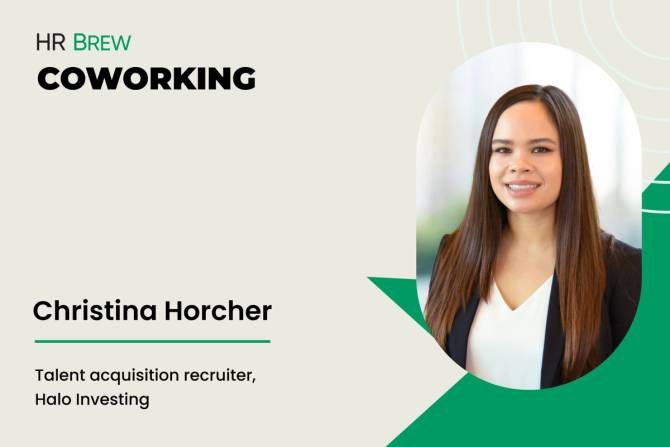
Christina Horcher
Here’s this week’s edition of our Coworking series in which we chat 1:1 with an HR Brew reader. Want to be featured in an upcoming edition? Click here to introduce yourself.
Despite myriad headlines touting the power of AI in recruiting, Christina Horcher isn’t sold just yet. As a recruiter at Halo Investing, she told HR Brew that she’s leery of its capabilities, especially when it comes to recruiting higher-level positions and executive searches, which is where Horcher got her start in the recruiting. One of the toughest positions she has filled at Halo was for an HR director, which took more than a year. She said that every candidate was different, and it was hard to assess what made for the best candidate.
At the financial services firm, Horcher has partnered closely with the different hiring managers to help them build out their teams with job descriptions and sourcing. Horcher said she’s especially excited about working to bring more diversity to the industry, which is “still mostly a boys club,” according to Horcher.
What’s the best change you’ve made at a place you’ve worked?
I joined Halo Investing as their first corporate recruiter right after the company had grown by 550%. Being the fast-growing startup that they are, they still had crazy hiring goals. The talent acquisition gap was huge! They didn’t have anything established in HR. I am visual, so I created an “essential metrics dashboard” that monitors the health of our talent acquisition pipeline and makes it easier to communicate with leadership. This drives change throughout the organization.
Keep reading here.—AD
|
|
Francis Scialabba
Today’s top HR reads.
Stat: Around one-third of HR leaders are using generative AI in the hiring process, and 48% are considering using it. (Greenhouse)
Quote: “If we don’t stand tall right now, we are all going to be in trouble. We are all going to be in jeopardy of being replaced by machines.”—Fran Drescher, president of SAG-AFTRA, on the use of AI in Hollywood (CNN)
Read: The Big Four accounting and consulting firms are slimming down as demand for consulting wanes post-pandemic. (the Wall Street Journal)
|
|
Tech Brew
|
Stat: Over 70% of Americans oppose AI’s use in final hiring decisions. Despite all the praise for and the promise of automation, workers still miss the human factor. HR professionals should take note of this report from Tech Brew on how applicants respond to new hiring tools like personality tests and chatbots.
|
|
|