Happy Tuesday! Looking for a theme for your next corporate lunch? Try Taco Tuesday, a time-honored tradition endorsed by NBA superstar LeBron James and that Mexican restaurant around the corner. Maybe it’ll even help you get folks into the office…
In today’s edition:
 Turning over a new leaf Turning over a new leaf
 Starting up Starting up
 Hemorrhaging in healthcare Hemorrhaging in healthcare
—Kristen Parisi, Sam Blum, Michael Schroeder
|
|
New Girl/Fox via Giphy
Americans aren’t the only ones dabbling in microdosing. Over the last 10 years, their governments have slowly nibbled away at recreational cannabis restrictions.
Today, marijuana is used recreationally by around 18% of US adults, and 68% believe the drug should be legal. Marijuana decriminalization was on the ballot in five states this Election Day, and as laws continue shifting across the country, one lawyer told HR Brew that HR leaders will need to consider their testing policies.
The results are in. Missouri, Maryland, North Dakota, South Dakota, and Arkansas all had marijuana legalization for adults over 21 on the ballot, and voters in Missouri and Maryland approved the legalization, making recreational use of the drug legal in 21 states and the District of Columbia. Medicinal marijuana use is legal in 37 states.
“A large part of why we’ve seen this explosion in [cannabis] legalization ballot initiatives and their success is because the views have changed on this issue pretty dramatically,” John Hudak, deputy director at the Center for Effective Public Management at the Brookings Institution, told Time.
Implications for HR. Jennifer Fisher, a cannabis lawyer at Goodwin law firm, told HR Brew that employers need to pay attention to changing laws. “Even if it’s not your state, what we’re seeing and have seen in the last few election cycles is a march towards legalization,” she said.
Jurisdictions including California, New York, and DC have laws ensuring positive marijuana tests do not affect employment. Some 14 states have laws protecting workers who use medicinal marijuana, though they have caveats that prohibit workers from using while on the job to ensure workplace safety.
As cannabis is legalized in more states, employers, including Amazon, have eliminated their marijuana testing. Keep reading here.—KP
Do you work in HR or have information about your HR department we should know? Email [email protected] or DM @Kris10Parisi on Twitter. For completely confidential conversations, ask Kristen for her number on Signal.
|
|
TOGETHER WITH ALBERTSONS COMPANIES
|
|
That’s right: You can help protect your employees during sniffly season by hosting an on-site vaccine clinic. Albertsons Companies provides on-site flu vaccinations in 34 states and Washington, DC, all administered by licensed healthcare providers.
Preparing for flu season has never been easier. Choose the date, time, and location that works best for your team and get vaccinated during your coffee break, over your lunch hour, or between calls. Talk about efficiency!
Working remotely or don’t have access to on-site facilities? No problem! Albertsons Companies offers alternate site clinics, as well as flu shot vouchers to help meet employees wherever they are. As a bonus, participants get a coupon for 10% off their next grocery purchase* (Terms & Conditions apply).
Let the vaccine pros come to you this flu season. Learn more about organizing an employee vaccine clinic here.
|
|
Boon Health
On Tuesdays, we get into the weeds with the founders of HR tech startups. Want to tell us about your company? Get in touch here.
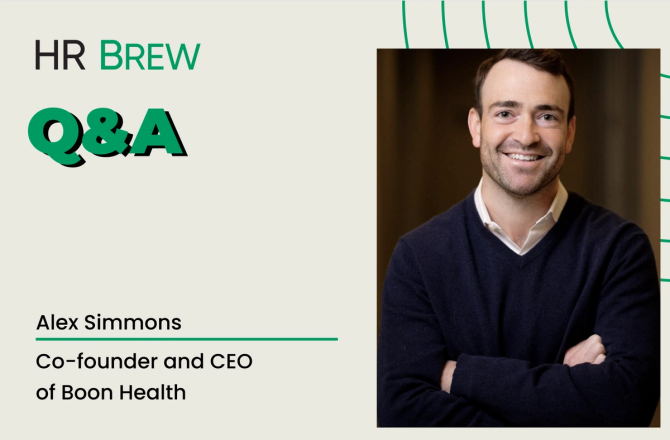
Alex Simmons is the co-founder and CEO of Boon Health, a personalized professional coaching platform for employees. The company was founded in 2019 and hasn’t accepted money from any investors. Boon Health strives to help workers advance, develop new skills, or take stock of their well-being through virtual career coaching and exercises pertaining to wellness and resilience. We talked to Simmons about how personalized coaching can boost retention, and about the future of HR tech.
What product or service does your company offer? We are a personalized one-to-one coaching platform for businesses. And we really see it as bridging the gap between mental well-being and professional development in the workplace—whether it’s coping with stress and anxiety or becoming a more effective leader…We have coaches that are a combination of [International Coaching Federation]-accredited coaches…[and] masters-level therapists who have formal coach training, as well as executive coaches with business operating experience.
How does the service work? Say we were to launch at Morning Brew. We would get the first name, last name, and email address of everybody at the company. The head of HR, or whoever is championing this internally, would send a message out to their team basically saying, “Here’s your new personal and professional growth resource.” We’d be sending their welcome email in the next 24 hours. It’s an introductory email, 100% confidential, and there’s an opt-in button to get started. If you’re an employee who wants to engage, you just fill out a quick survey, basic demographic information, age, tenure, role at the company, etc. Then we ask, “What are you looking to work on? Is it more coping with stress and anxiety? Is it leadership development? Is it more personal or professional in nature?” From there, we are sending you to coach-matching options that are the best fit for you.
What specific issue in HR does your company intend to solve? Keep reading here.
Want to be featured in an upcoming edition of Starting Up? Click here to introduce yourself.
|
|
Morsa Images/Getty Images
More than 4 million US healthcare workers called it quits between January and August—that’s about 20% of the sector’s workforce, according to the Labor Department. And HR pros have been scrambling to staff up ever since. Healthcare Brew’s Michael Schroeder recently reported on how they can recruit and retain talent.
When it comes to retaining and attracting staff, hospitals are no longer just competing with one another or with pharmacies like CVS and Walgreens, which have been expanding the healthcare services they offer. They’re also up against Big Tech giants Amazon, retailers like Walmart, and other non-traditional healthcare employers, said Vicki Cansler, senior vice president and chief human resources officer at Piedmont Healthcare in Atlanta.
That means health systems have to be more nimble, like with scheduling. Cansler stressed the importance of flexible-staffing arrangements, especially for clinical staff, which would give employees more options for the hours and days they work.
“If you don’t offer that flexibility, somebody else will,” she said.
Keep reading on Healthcare Brew.—MS
|
|
|
Power to the people. Developing and retaining your best people is ridiculously important. With Leapsome’s people enablement platform, your team can set processes for strategic goal setting, performance feedback, measuring engagement, and more. Plus, Leapsome provides insightful analytics that can inform your people strategy. Schedule a demo here.
|
|
Today’s top HR reads.
Stat: Meta’s stock was up 20% on Thursday from the week prior after CEO Mark Zuckerberg announced layoffs affecting 11,000 workers. (Vox)
Quote: “In most big companies, for the mid-level managers, they incentivize the number of people they manage…That, in the end, leads into the situation that we’re in right now, which is hiring people willy-nilly, and now the people who suffer in the end are the workers.”—Apoorva Govind, a startup founder and former software engineer at Uber, on the bloat that’s leading tech companies to conduct layoffs (Protocol)
Read: The Apple store’s Genius Bar jobs used to be highly sought-after. Now, workers say they’re just like any other retail job—a factor that has contributed to a labor movement at the company. (Bloomberg)
IT can be easy: We teamed up with Electric to survey 500+ tech decision-makers about the challenges and solutions to scaling in today’s environment—and how they’re leveraging the right tools to alleviate common pitfalls for good. Read their insights here.*
*This is sponsored advertising content.
|
|
-
Amazon is reportedly planning to layoff around 10,000 employees, primarily across retail and HR.
-
Salesforce reportedly adjusted its policies to make it easier for managers to terminate employees based on performance in preparation for layoffs.
-
Workforce participation for older Gen Z workers was 70.8% in October, down from 72.1% in 2019.
-
Women’s employment in the construction industry is on the rise.
|
|
Catch up on the top HR Brew stories from the recent past:
|
|
|