Hello there! Our hot take? The key to making solid points at work is to back them up with data that your colleagues can easily understand. But making data digestible is no easy feat—unless you take our Data Storytelling course. We’ll teach you everything you need to know to build dashboards that deliver your insights beautifully.
In today’s edition:
 Skills > degrees Skills > degrees
 Listen up Listen up
 Engaged Engaged
—Adam DeRose, Sam Blum, Vicky Valet
|
|
Mphillips007/Getty Images
The tight labor market has had some recruiters and hiring managers feeling a bit like those canvassing on busy downtown blocks asking strangers if they have a minute to talk about X, Y, or Z. Companies have responded by considering new ways to get butts in seats, and now lawmakers are on the case.
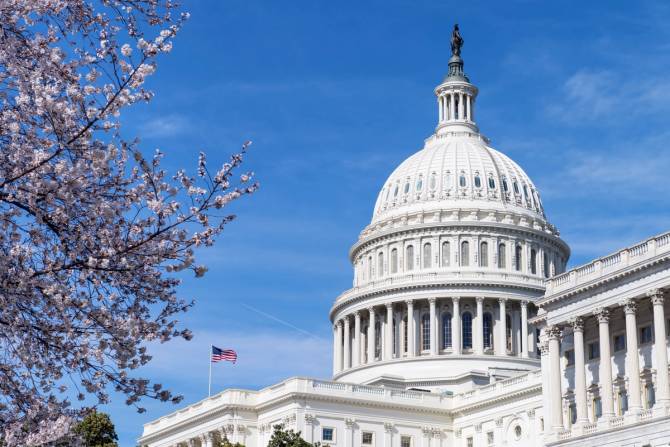
The business community’s embrace of skills- and cert-based hiring practices is growing, reversing a decades-long trend of adding degree requirements to job descriptions. And the emphasis on alternative career pathways also has support in the halls of the US Capitol.
House Republicans last week introduced a bill that would open federal Pell Grants, previously only available to college undergraduates, to students looking to enroll in skills-based education programs.
The Promoting Employment and Lifelong Learning (PELL) Act—sponsored by Republican Conference Chair Elise Stefanik and House Education and Workforce Committee Chairwoman Virginia Foxx, among others—amends the Higher Education Act to include qualified, short-term programs as eligible for a “Workforce Pell Grant.”
Approved programs would be determined by the Education Department, and the agency would also collect and publish data on costs, enrollment, and completion and job-placement rates.
If passed, more students from financially disadvantaged backgrounds will have access to Pell funding in order to participate in educational programs other than traditional two- and four-year colleges and universities.
As employers across industries struggle to find qualified workers, proponents of the bill say additional financial aid opportunities for workers will increase the number of candidates competing for roles in sectors like tech, as well as manufacturing, construction, transportation, and health sciences, according to an email by Education and Workforce Committee Communications Director Audra McGeorge. Keep reading here.—AD
|
|
|
Katie Gatti, author of our Money with Katie newsletter, is obsessed with personal finance—specifically the loopholes, nuances, and big questions that traditional advice tends to lack. Her weekly newsletter takes a spicy approach to spending habits, investing best practices, tax strategies, credit card hacks, and more.
It’s time to start manifesting your financial freedom. Sign up today and get simple, practical ways to live a rich life delivered straight to your inbox for free.
|
|
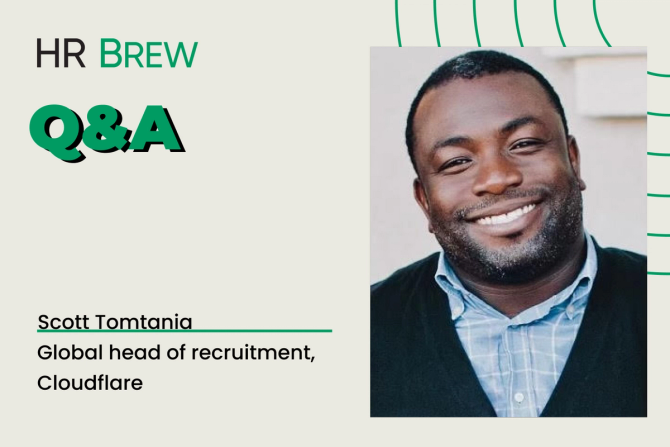
Scott Tomtania never planned to pursue a career in HR. After graduating from East Carolina University’s MBA program, he worked in sales until he was recruited into the search profession. Nearly two decades later, he’s the global head of recruitment at IT services firm Cloudflare, a position he has held since 2017. In a conversation with HR Brew, Tomtania shared his views on how HR leaders should think about the racial makeup of teams and what they can do to make the field more inclusive for the next generation.
This interview has been edited for clarity and length.
What is the best policy change or update that you’ve made in a place you’ve worked?
During Cloudflare’s interview process, we have [the] candidate meet someone that would be outside of their team [and] typical workflow, and this intentionally adds another layer to ensure that diverse groups and…thinking is part of the entire consideration of Cloudflare…And it’s served us really, really well.
Surveys suggest about 10% of HR professionals are Black. How do you think HR should be thinking about the racial makeup of people teams?
I firmly believe that the most productive, the most successful companies have to be diverse, because we have to reflect the market that we serve…to be able to do that, our teams also have to be diverse, so that we can gain a clearer understanding of what those segments of the population are. Along with that, the best place to start is the HR team. We can help the entire company become diverse if the HR team is diverse.
What should HR leaders do to ensure they’re creating an inclusive environment for the next generation of HR leaders?
The number one thing I would tell HR leaders…is, first: listen, listen, listen. The world is a fast-changing place. Keep reading here.—SB
|
|
Today’s top HR reads.
Stat: Thinking about switching industries? VPs of HR in the cannabis industry can expect to earn a median salary of $211,550 this year. (Cannabiz)
Quote: “There is a lot of fear about losing their job. If they are undocumented, [they fear] getting deported and losing their housing.”—Joaquin Jimenez, vice mayor of Half Moon Bay, explaining why he thinks farmworkers told HR they were ready to return to work just a week after the mass shooting at their worksite (ABC7 News)
Read: If your HR team is like most in corporate America, it has likely spent a pretty penny trying to measure and boost employee engagement. Unfortunately, it doesn’t seem to be working. (the New York Times)
|
|
-
McDonald’s former CPO has been directly named in a lawsuit for allegedly enabling a culture of sexual misconduct at the company, a move that may open the door for possible legal claims against other heads of HR.
-
Groupon has cut 500 employees in a second round of layoffs.
-
Google is being sued by a former executive who alleges he was terminated after filing a sexual harassment complaint against a fellow employee.
-
OSHA announced new, stricter enforcement guidance that will take effect on March 27.
|
|
Catch up on the top HR Brew stories from the recent past:
|
|
|