Patricia Chang
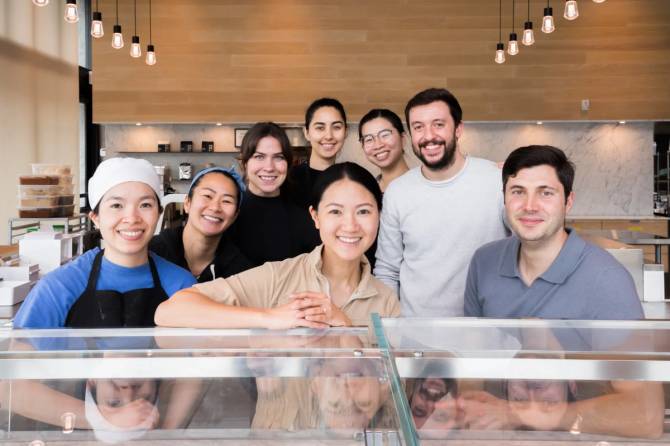
In 2017, Amanda Nguyen left her job at Facebook to start Butter&, a cake shop in San Francisco. Her fiancé Ted Moran left his job at Uber to be a co-founder. In their quest to hire cake-makers to join this venture, they knew they had to find a way to sweeten the deal.
Starting a new business is tough, particularly in the food industry, but they had a plan to stand out as retail employers: offer stock options to their first employees as part of a larger mission to be an ethical employer.
“I had no idea what running a small business would be like,” Nguyen told HR Brew. But she knew she wanted to provide stability for her employees and a sense of ownership, “That’s why we registered it as a C-corp and give away equity to our employees.”
Cake stock. Moran told HR Brew that maintaining a Delaware C-corp in order to provide stock options does carry additional legal and compliance costs. “There’s a little more overhead that there needs to be, running this program for a smaller cake shop,” he told HR Brew.
But the benefits are hard to ignore. Nguyen and Moran have kept their employees for four or more years (or well over twice as much as the average for food service workers, according to the Bureau of Labor Statistics), get cost-saving ideas from staff, and that people get rewarded for building the shop into a successful business by receiving an asset that increases along with the value of the business.
At other companies in the food industry, if employees are involved in a place that gets big, “They leave and all they get is the accolade of having been an opener,” Moran said. “But they don’t actually get any piece of what they created. That’s the main thing we wanted to change.”
Keep reading.—AK
|
|
|
Tired of scrolling through endless articles in search of the latest business news? Look no further than Morning Brew’s free daily newsletter. Whether you’re a seasoned professional, a budding investor, or simply someone who wants to stay up to date on the business and finance world, Morning Brew has you covered. Its writers sift through the noise to bring you the stories that matter most to your bottom line in one concise, quick-to-read email every day of the week.
Join 4m+ people who start their day with the Brew and discover why it’s the ultimate source of business news. Sign up now so you don’t miss a beat.
|
|
Culture Amp
Imagine getting paid to be a taste-tester in the Taco Bell test kitchen. More cheese in your Crunchwrap Supreme? Absolutely. Extra-flaming fire sauce? Coming soon (we hope).
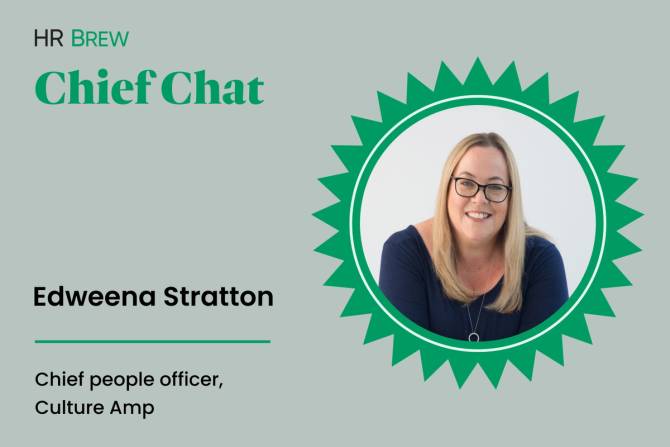
Now, take that concept and make it for your wildest dreams of HR tools. That’s one of the benefits that Edweena Stratton, chief people officer at Culture Amp, gets to experience in her role. After joining the company a little over a year ago, she shared what it’s like being “customer zero” at an HR tech company, how to lead a global HR team, and plans for 2023.
How do you recommend HR professionals manage global teams?
Invest in spending time on the ground. If I reflect on my experience managing in Asia Pacific, I spent a ton of time in both India and Singapore, Hong Kong, wherever it needed to be.
The second thing that I would recommend is, be really curious. So, ask a ton of questions [and] do your research. Your experiences are not necessarily right…there’s no right and wrong. It’s just different. So, it’s appreciating different perspectives. I learned a ton [by] understanding and appreciating those differences versus trying to force what I considered my norms or perspectives on others.
I would also encourage people to make sure that they had strong leadership on the ground. You need really strong leadership—somebody who you can partner with and trust.
Keep reading.—KP
|
|
Illustration: Dianna “Mick” McDougall, Photo: PhonlamaiPhoto/Getty Images
Artificial intelligence is becoming a coworker of sorts for all kinds of employees.
As breakthroughs in generative machine learning have spawned a flurry of cutting-edge AI tools, a new report finds that workers at higher levels of companies are starting to see the effects.
The survey, from automation platform Kizen, found that nine in 10 workers who made at least $100,000 a year reported using AI in their work life.
Meanwhile, just 15% of those making between $50,000 and $99,000 per year reported using the technology, while a quarter of respondents who made less than $50,000 per year said the same. The company said it surveyed around 1,500 workers overall.
“People who are perceiving AI are either younger [or] likely getting more exposure to what it is through their regular channels,” Kizen CEO John Winner said. “Or they’re more in white-collar positions, where they’re probably being involved in conversations about how this is going to be helping increase efficiency.”
The result comes as a host of Big Tech companies are starting to integrate generative AI into their enterprise software suites. Announcements and rollouts like Microsoft’s Copilot, Google’s Bard, and Adobe’s Firefly have aimed to weave AI capabilities into everyday work tasks, like writing emails, filling in pitch decks, or generating content.
Keep reading at Tech Brew.—PK
|
|
Today’s top HR reads.
Stat: The US added 236,000 jobs in March, around 90,000 fewer jobs than in February. (CNN)
Quote: “The days of a three- to five-minute video from the CEO on why it’s great to work there are over.”—Neil Costa, founder of HireClix, on why employer branding is focusing more on employee influencers than on leadership (Forbes)
Read: The constant struggle to find the right work–life balance. (Insider)
Shift into hire gear: By deploying Paradox globally, GM’s hiring team saved $2m in recruiting contractor costs…in under 6 months. And the benefits didn’t stop there. Get the full scoop in Paradox’s latest webinar.*
*This is sponsored advertising content.
|
|
-
Recruiters at some tech companies say that despite their nearly $200,000 salary, there wasn’t much work to do.
-
Kansas passed an anti-ESG law that prevents government workers in the state from considering ESG principles when allocating grant money.
-
The Department of Labor found that 80% of garment manufacturers in Los Angeles were breaking wage and hour laws.
-
Walmart is giving employees across the country access to pickleball courts as its latest perk.
|
|
|