’Ello! It’s Wednesday. It’s hump day, and Harry, it’s you that has to go on, I know it. Not me. Not Hermoine. You.
In today’s edition:
 Pay up Pay up
 Leave alert Leave alert
 Coworking Coworking
—Courtney Vinopal, Adam DeRose
|
|
William_potter/Getty Images
Bills that many Americans had been dreading finally came due in October, as student loan payments resumed after a more than three-year pause.
There are over 44 million student loan borrowers in the US, and while those who don’t make payments right away are protected from default for another year, the interest on their loans will begin accruing again.
So far, the Biden administration has erased $127 billion worth of student loan debt for some 3.6 million borrowers; a plan to cancel more than $400 billion in debt was struck down by the Supreme Court. Overall, borrowers hold about $1.6 trillion in outstanding student loan debt.
Absent more comprehensive legislation, some employers are stepping in to support workers with student loan debt. There are two pandemic-era policies, in particular, that HR pros can look into as payments resume.
Keep reading here.—CV
|
|
Work is in the middle of a vibe shift: accelerating labor crunches, evolving work expectations, skyrocketing labor costs. Things are, well, changing. That’s why it’s superrr important to boost all of your outdated workforce management systems (WFM) into the future.
Fortunately, Workday can help. They put together a new guide that outlines 3 hidden costs of yesterday’s WFM practices and how Workday can address their root causes. Prepare to embrace a powerful new approach to management.
What’s so bad about outdated WFM practices, anyway? They often involve inefficient manual processes that can waste time, create needless errors, and generate poor-quality data. In short, they create headaches for your biz.
Step up your WFM game.
|
|
Chinnapong/Getty Images
New mandated leave alert in California: Employers in the Golden State will soon be required to offer employees up to five days’ leave for a reproductive loss.
California’s SB 848 requires both private and public employers with five or more workers to allow employees to request time off if they’ve suffered a reproductive loss. The measure stipulates that the leave doesn’t need to be taken consecutively and can be taken within three months of the loss event.
Reproductive loss. California defines reproductive loss as a failed adoption, failed surrogacy, miscarriage, stillbirth, or an unsuccessful assisted reproduction.
“Workers are often playing the ‘boss lottery,’ depending on what their access to flexible benefits might be,” said Jen Stark, codirector of the Center for Business and Social Justice at BSR. “This [law] tries to mitigate some of the ‘boss lottery’; if I tell my boss that I’m experiencing pregnancy loss or miscarriage, that I should have access to leave.”
Keep reading here.—AD
|
|
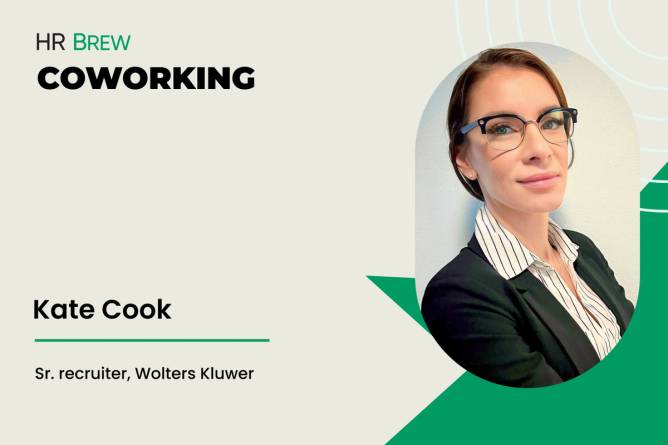
Here’s this week’s edition of our Coworking series. Each week, we chat 1:1 with an HR Brew reader. Want to be featured in an upcoming edition? Click here to introduce yourself.
Kate Cook is a senior recruiter for information services company Wolters Kluwer, and she’s been doing talent acquisition (TA) for much of her career. “I’ve done everything imaginable…I’ve recruited for every kind of job…IT to entry level to manufacturing,” she said. Cook gets to make calls to people all across the country, and she doesn’t screen systematically; she really tries to get to know candidates, sometimes even wrapping up calls where recruiter and candidate are “both just crying.”
Cook said that building relationships with candidates is one of her favorite parts of the job, especially if she’s able to make an offer to a candidate who’s excited about a role. Cook is confident in her recruiting process, noting that “some people are just bad at interviewing,” but that doesn’t mean they’re not right for a job. She’ll explain to the hiring manager why she believes a person might be a good fit for an open role, even if they’ve bombed the interview.
What’s the best change you’ve made at work?
When I worked at Fox World Travel, my HRBP and I implemented Friday dance parties. Friday afternoons, we’d go to the different departments and play music and get employees to dance with us. It sounds silly, but it was very well received and really boosted morale. People enjoyed it so much that they would send us emails asking what time the HR dance party was coming around. That’s one of the odder yet effective things.
Keep reading here.—AD
|
|
|
The clock is ticking. Trying to figure out what’s causing high turnover, low performance, and disengagement? Get the answers before they impact your org’s bottom line. 15Five’s performance management platform is your one-stop shop for performance reviews, engagement surveys, and feedback tools—and that’s just for starters. Join the 3,500 other companies that are driving results with 15Five.
|
|
Francis Scialabba
Today’s top HR reads.
Stat: Workers in the construction and extraction industry suffer the highest rates of overdose deaths by occupation according to the CDC. (the Washington Post)
Quote: “We have support organizations that are wondering if they need to scrub the word Black from their websites, or people of color, or rethink how they describe their work.”—Kelly Burton, CEO of Black Innovation Alliance, on the rise of lawsuits targeting DE&I programs and policies (the Wall Street Journal)
Read: Developers are creating AI “agents” that could eventually replace humans and automate many office roles. (the New York Times)
HR you listening?: When TechSmith needed a way to boost open enrollment rates, they looked inward. See how they used short, engaging videos to turn things around in our latest article, sponsored by PwC.*
*A message from our sponsor.
|
|
|